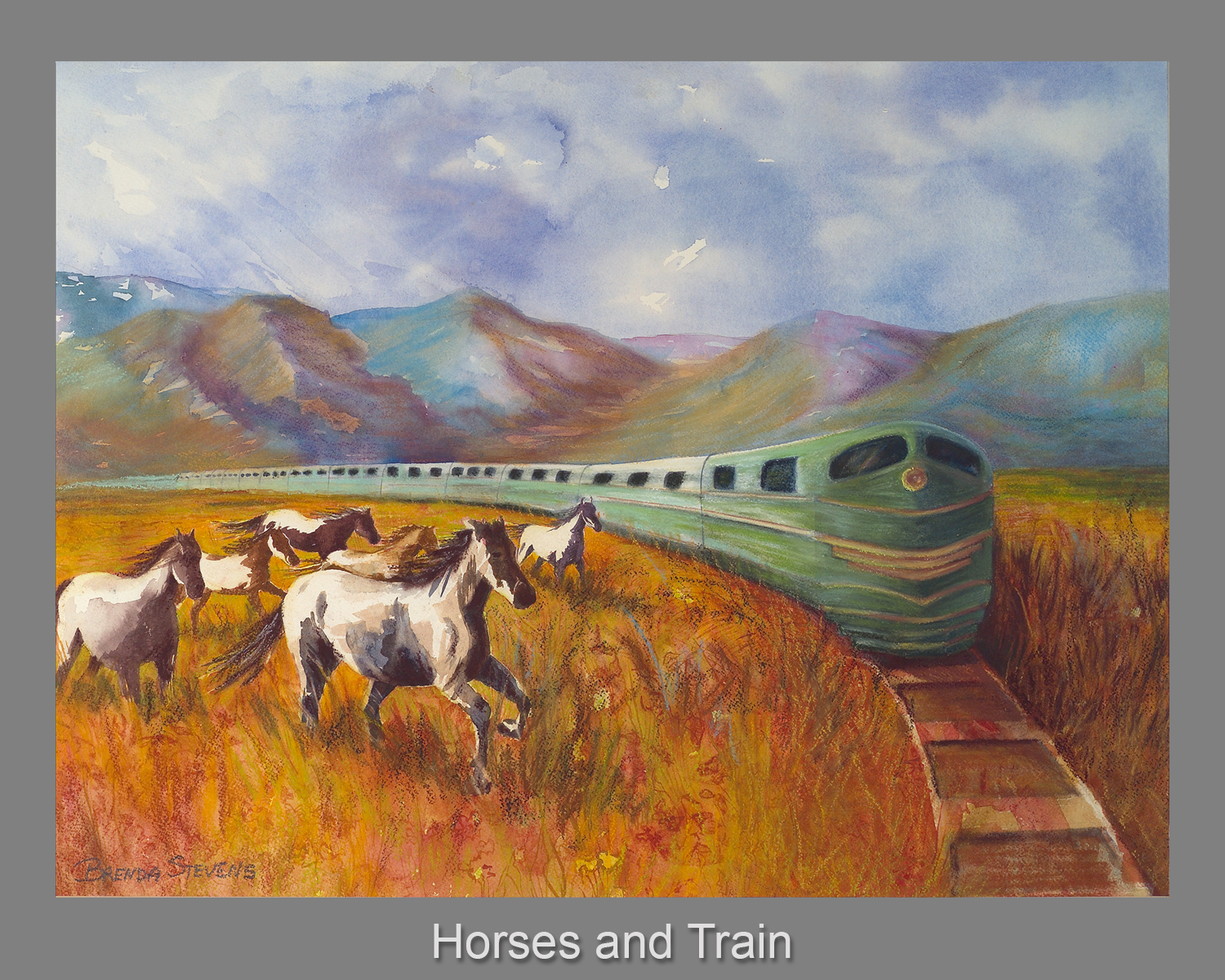
Horses and Train
“The Master has failed more times than the Beginner has even tried.” I don’t know who said this, but the words are encouraging to all beginners who tire of failed attempts and want to give up.

Horses and Train
“The Master has failed more times than the Beginner has even tried.” I don’t know who said this, but the words are encouraging to all beginners who tire of failed attempts and want to give up.
Last year I painted two commissioned house portraits for the same client. Photographs of each painting can be seen in my earlier posts: November 24 and December 10, 2013; “Old Homeplace in Hawkinsville” and “Hawkinsville Summer Home”. The colors for both paintings were made from the same limited palette of carefully chosen primaries. This insured they would compliment each other if displayed side by side. I also chose a color scheme that would compliment the client’s home decor and would be appropriate for the subject matter. I must also give some thought to the painting’s mood. Will it be edgy or serene? After those decisions were made I had to decide which primaries I wanted to use. I always use a limited palette of primary colors. All of the colors in these paintings were mixed from reds, blues and yellows. I chose two reds; Permanent Rose and Scarlet Lake, two blues; Cerulean Blue and Prussian Blue, and two yellows; Winsor Yellow and New Gamboge. Six tubes of paint. By selecting a limited palette of primary colors, my mixes harmonize without much effort. Using a limited palette of primary colors sounds simple, but involves careful selection.The challenge is how to distill my many experimental mixes down to six tubes of paint and meet all the criteria I need for a particular painting. Pigments have characteristics particular to each one. For example, I must decide if I should use an opaque or transparent yellow, a granulating or smooth blue, a staining color or one that is easily lifted. I chose Cerulean Blue because it is blue, of course, but it also has a strong granular quality and I wanted that quality in my mixed colors for grass, trees, and the house shadows. I chose Prussian Blue for the sky because is has a smooth quality. These particular blues, when mixed with Scarlet Lake and New Gamboge, produced some wonderful grays and dark colors. Various combinations of these colors also produced pleasant and varied greens and browns. I start my selection process with a goal in mind and then I just have fun experimenting with color.
For example, Cerulean Blue is a granulating color while Prussian Blue is not.
“Art is the only way to run away without leaving home.” Twyla Tharp, American dancer (1941- )
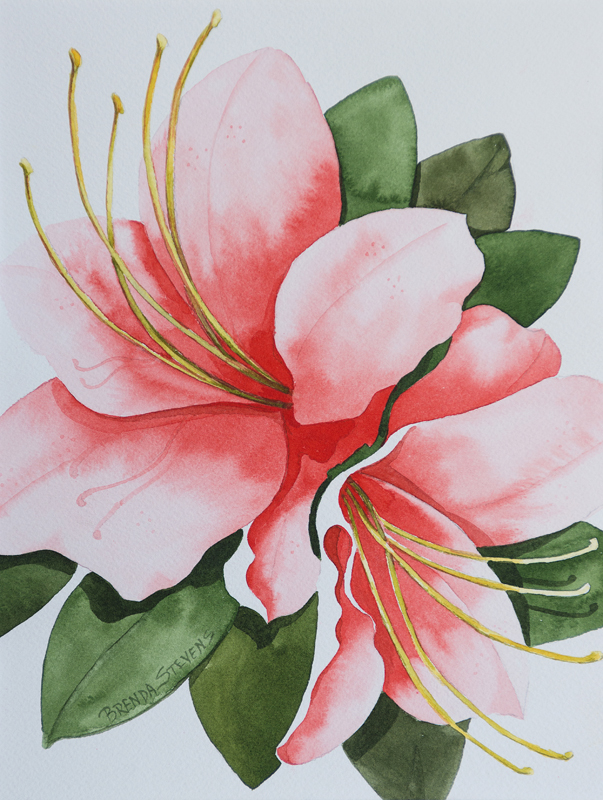
“Watercolor Crash Course!” at Sunnyside School, in Harris County, this Saturday. “Prunifolia Azalea” will be our subject. No painting or drawing experience is necessary. You will be walked, step-by-step, through the painting process and in just four hours you will have a small painting to take home. All materials will be provided. $65. registration required. Call 706-888-1110.
 My beginning watercolor students are required to make a color wheel. This exercise is not easy and at some point I’m certain they wonder, “Now What? How does this thing work and why do I need it?”. A better question would be, “How can I make this thing work for me?” Color theory is particularly relevant to professions such as painters, photographers, architects, interior designers, animators, graphic designers, print makers, filmmakers, hair stylists, in other words… anyone who uses color in their line of work. A color wheel is a visual representation of the color spectrum that is simply wrapped around a circle. Color theory is the study of the positional relationships of these colors as they appear on this wheel, for example, yellow is always opposite purple and blue is always opposite orange. Opposite colors are called complementary colors. Color theory is considered a body of practical guidance that gives the artist guidelines as to the mixing of colors. It saves hours of wasted time and a lot of money in wasted paints. Mixing colors that are opposite each other on the wheel will result in grays, browns and other neutral colors; sometimes referred to as mud. A more controlled, careful mixing of these colors will result in beautiful grayed or toned down colors. Mixing complementary colors is the classic way of making neutral or toned down colors. All the hair salons know that understanding the relationships between primary, secondary and tertiary colors is essential. Color correction is a big deal to hair salons and when you understand the wheel concept you’ll be able to neutralize the unwanted tones simply by adding the complementary color.
What do watercolor and jazz have in common?
Both are improvisational and neither respond well to micro-management.
I’ve always been a big fan of Norman Rockwell’s work and saw an exhibit of his paintings at the High Museum a few years back. A current exhibit of Norman Rockwell works are at the LaGrange Art Museum, now through August 22.
Also, I’ve learned of a reception and showing of Winston Churchill’s paintings on August 5 at Hills & Dales in LaGrange, at 6:30 pm. His grandson will give a lecture and there will be six of Churchill’s paintings to see. Cost for the reception, exhibition and lecture is $10. per person. Reservations required, call 706-882-3242.
Students at Sunnyside Community Club are going into their fourth week of watercolor and drawing instruction. The first three weeks have been spent learning how to make and use a color wheel, practicing a few painting techniques, and developing drawing skills. This Wednesday we will begin “observation” training. (A contour drawing of the subject can provide the perfect path to access one’s natural ability to process visual information. Understanding color; how to analyze the color in a subject and how to select and mix primaries to duplicate that color. This is the key to harmonious color schemes, creating complex color rather than flat out of a tube, and making clear, glowing color instead of muddy mixes.

Nine students are taking my Drawing Fundamentals class at the Turner Center. Tuesday night we talked brain science; how the brain’s right hemisphere possesses a superior ability to process visual information, while the left hemisphere relies on memory and a symbol system developed in childhood. The class did contour drawings and upside down drawings to engage the right hemisphere. The usually dominate left hemisphere was unable to do these exercises and had to step aside. It is fascinating, that we can learn to use each hemisphere to its best advantage. The left hemisphere houses language, mathematical skills and logic. The right is all about intuition, mindfulness, leaps of faith and solving visual puzzles.

 brendaswatercolors.com